
Images of Wales
Special Feature
Where's that?? - locate Pengam on a map of Wales.
The Village of Pengam
Bedwellty Parish, Monmouthshire
Photography by John Ball - late February & early April 2000
(scanned from colour prints taken with a Sigma SA-300 35mm single lens reflex camera)
Pengam is a former coal mining community in the Rhymney Valley of South Wales. Most of the village is on the east bank of the river, in old Monmouthshire, but those parts of the village on the west bank are known as Glan-y-Nant and are in the old county of Glamorgan.
 Anthony Jenkins, who was born in Pengam and lived there through the 1940s and '50s, has kindly provided his fascinating personal memories of the village. Read Anthony's reminiscences by clicking on the "memory" buttons (e.g. left) placed alongside the caption under the relevant photograph. Each button accesses a different set of memories.

| Above: Approaching Pengam from the east.
We are looking westwards down Pengam High Street. The road descends steeply to a bridge over the River Rhymney. A left turn near the bottom of the hill takes us into Commercial Street, once Pengam's main business thoroughfare, and a direct route to the next village, Fleur-de-lis. Across the river is Glan-y-Nant in the county of Glamorgan. |
In March 2026, Dr John Hughes contributed his memories of the railway, prompted by the view (above) down Pengam High Street:
To the left of this picture between 1836 and 1962 was the entrance to Pengam (Monmouthshire) railway station. Normally, the railway during my time was mainly taking coal down to Newport and providing a not-very-frequent passenger service.
Except once a year it was really important. Members of the chapels and churches of Pengam organised a day out at Barry Island for the whole village. My father and I (until he died) and my Uncle Emlyn Price thereafter, both deacons at Bont chapel, sold tickets at Pengam station for a special journey by train to Barry Island and back. Effectively the chapels and churches hired a train. I even have the paper on which my father wrote down the takings one year for the trip to Barry. This was for the grand total of £21-6-1(i.e. pounds, shillings and pence).
Was this an unusual train journey? Yes. Chapels and churches didn't often hire trains. And in those days the Rhymney valley had two train lines: one in Pengam, Monmouthshire and the other across the valley in Pengam/Glan-y-Nant, Glamorgan. Normally the trains from one side of the valley went down to Cardiff or Newport respectively. Instead, on this special day out, the steam train took us north to Aberbargoed, and as I remember it, across the viaduct there and on to the Rhymney-to-Cardiff line, and beyond that to Barry Island.
It was an unusual and special day out!
John Hughes has kindly contributed other Pengam memories (see Pengam Baptist Chapel, below).
|
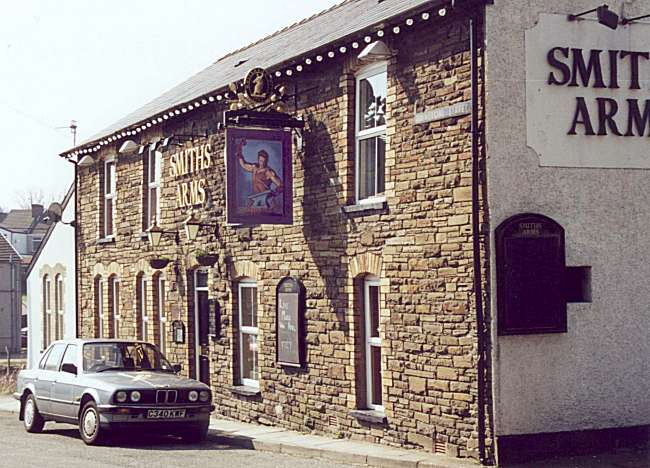
Above: The Smith's Arms public house, Commercial Street.
Thirsty miners must have downed many a pint here. |
 
| Above: The former Pengam Baptist Chapel, Commercial Street.
The chapel was originally sited near the bridge over the river Rhymney and was known as the "Bont Chapel" (bont is Welsh for bridge). The chapel was still known locally by this name even when moved to the present site in Commercial Street.
As the wall plaque tells us, the chapel was built in 1857, and extended in 1865. The chapel is now a private residence. Sadly, the conversion of the building into a private home seems to have been achieved with scant regard for its former purpose. The wall plaque above the front entrance is the only external artefact left in its original state. |
 In November 2005, after seeing the above photos of Bont Chapel, Peter Walker wrote: In November 2005, after seeing the above photos of Bont Chapel, Peter Walker wrote:
My grandparents, Inkerman Walker and Sarah James [right], were married in the Bont Chapel, Pengam on 5th September 1911. They lived at Hill View, Commercial Road, Pengam and my father was a pupil at Lewis School. My grandfather's unusual forename of Inkerman was apparently because an uncle was killed in the Battle of Inkerman [1854] in the Crimean War. We used to have a Welsh slate clock which bore a brass plate commemorating my grandparents' marriage - it was a wedding present to them. Sadly, it was stolen during a burglary in 1993. Sarah, my grandmother, was a teacher in one of the local primary schools.
[Inkerman Walker was one of the children of George Walker, a coal hewer, originally from Somerset, England, and his wife Janet. At the time of the 1901 census, George and his family were living at 17 Long Row, Cwmsyfiog, Bedwellty.]
In March 2026, Dr John Hughes was prompted to share with us his own memories of Bont Chapel:
My father, Billy Hughes, was a Welsh-speaking deacon of Bont Baptist chapel and a lay preacher who often preached at other chapels, as needed, in the village. I still have some of his hand-written sermons. Alas he died in 1956 when I was eight years old.
I vividly remember going with my father to morning services, all in Welsh apart from a five-minute story in English for the children. For that reason, although I am not a Welsh speaker, I am able to pronounce and sing hymns (badly) in Welsh with what I am told is a typical valleys Welsh speaking accent!
The pulpit in the chapel loomed large over the Big Seat where the deacons, including my father, sat. Underneath that pulpit was the tank in which baptisms took place. So, there was plenty of room for the minister to give a bravura performance of a sermon, walking around the pulpit and sometimes leaning over the balustrade to make a particular point.
Sunday school was in the rather large vestry at the rear end of the chapel where Band of Hope meetings also took place during the week. All the children were encouraged to do something; singing, reading the Bible out loud, drawing pictures etc. And on occasions the older teenagers were invited to lead part of the service in the evening.
Those evening services were in English with alternate hymns in Welsh and English. And, of course, if the singing, particularly of a hymn in Welsh was going well, somebody would strike up to sing the last half of the last verse twice.
Over time, the congregation became much reduced, but certainly, in the 1950s and early 1960s the chapel was pretty full, including the gallery upstairs.
The organ was located behind the pulpit and the organist was Sally Morgan who lived in Nydfa road, adjacent to the chapel. The only problem with the organ was that someone had to pump it for it to work! Older teenagers and male adults took turns on a roster to pump the organ. We sat or stood behind a curtain to the right of the organ and pumped away. We would come down with the organist into a pew to one side of the pulpit to listen to the sermon.
Bont was a very friendly place. I called about 20% of the congregation Uncle or Aunty... even though there was no blood relationship at all. For example, Sally Morgan was Aunty Sally to me!

| Above: Pengam Cemetery, off Old Vicarage Close.
The oldest tombstones date back to the mid nineteenth century. At the time I took this photo, the sky was looking very threatening! |

| Above: St David's, the parish church of Fleur-de-lis.
This is a new church and a new parish, probably just over 100 years old. The church is at the southern end of Commercial Street at the point where Pengam village ends and Fleur-de-lis village begins. From here, Commercial Street continues as High Street, Fleur-de-lis. |

| Above: Nydfa Road, Pengam.
Nydfa Road takes us from Commercial Street down towards the river, marked by the line of trees on the far side of the rugby football field. A Victorian Ordnance Survey map shows this may be the site of a former colliery. |

| Above: River Rhymney, looking to the south (downstream).
The picture was taken from the bridge connecting Pengam (Monmouthshire) with Pengam (Glamorgan). Monmouthshire is on the left, Glamorgan on the right. The Rhymney rises about 10 miles north of Pengam, in the Brecon Beacons National Park, and enters the sea near Cardiff, about 15 miles south of Pengam. |
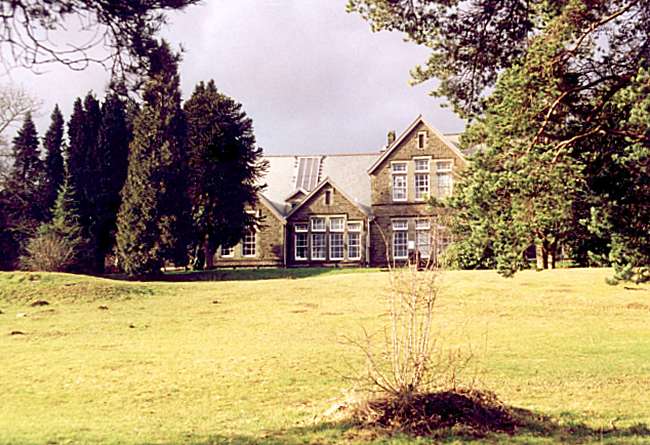
| Above: The Lewis Boys Upper Comprehensive School, New Road, Pengam.
In Glan-y-Nant, just across the bridge over the Rhymney, is the Lewis Boys School. The old school buildings date back to about 1870 when the school moved to its present [April 2000] location from Gelligaer where the school was first established in 1729. Many thanks for this information to Paul Fisher, a "Ludovican" (Old Boy) of the school.
Headteacher Dr Chris Howard says the school will search its archives on request, for a fee of £10. The school also keeps a mailing list of Old Boys. Anyone interested in contacting the school may do so at lbuca@caerphilly.gov.uk. Find out more about the school by visiting its website at:
http://www.caerphilly.org.uk/lewisschoolpengam/ |
In July 2007, Mrs Doreen Dixon provided the following story of her family's links with Pengam and Fleur-de-lis:
My older brother Albert Page attended the Lewis Grammar School for Boys (as it was then known) when we were evacuated  from Kent from about 1940 to 1945 during the Second World War. I was just seven years old at the time, being born in 1935. We were evacuated to several areas in Wales, ending up at 23 Powell Street, Tir-y-berth next to 'The Flower' as we called it at the time. The photo (right) shows my brother (second from the right, front row) with other boys and masters in the school choir. I know he enjoyed his time there but unfortunately he was killed in an accident whilst doing his National Service in 1948 with the Fleet Air Arm. from Kent from about 1940 to 1945 during the Second World War. I was just seven years old at the time, being born in 1935. We were evacuated to several areas in Wales, ending up at 23 Powell Street, Tir-y-berth next to 'The Flower' as we called it at the time. The photo (right) shows my brother (second from the right, front row) with other boys and masters in the school choir. I know he enjoyed his time there but unfortunately he was killed in an accident whilst doing his National Service in 1948 with the Fleet Air Arm. |
In December 2009, David Keith Jones wrote:
May I say how much I enjoyed your Pengam pages which brought back many memories. You have done a great job! Anthony Jenkins and I were school friends especially during 1958-60 and we still keep in touch. I am a native of Bargoed, but my family moved to Cardiff in 1962. You might be interested in my relevant musical videos on YouTube under the name VoceVersatile:
'Nos Galan'; 'B Train to Bargoed'; 'Bargoed - Fy Nhref'; 'Don't get around much any more' (i.e. to Pengam); 'Rachie - I bob un sydd ffyddlon (o Fargoed)'; 'Bugeilio'r Gwenith Gwyn'; etc (several other Welsh songs among the 200 uploaded)
Hwyl fawr, David Keith Jones |
In January 2009, Mr John Richardson was prompted to offer his own fascinating reminiscences of Pengam and district:
I have today been looking at your photographs; they stirred a few thoughts of my year at Lewis School, Pengam.
I spent all the WW2 years in Trelewis with two aunts and their families who lived on a farm; happy days. My parents and siblings lived in Richmond, Surrey, where my father was a firefighter. I have been told that the family was visiting my mother's family when the war started and someone thought it would be a good idea to leave me in Trelewis. My sister and brother spent short periods of time at Ystrad Mynach and Cascade with other aunts, but kept returning to Richmond. |

Source: Google Maps UK |
I started my schooling at Trelewis School in September 1939 and somehow passed an examination to progress to Pengam in September 1944. I remember the bus journeys to and from Pengam, and some of my fellow passengers from Trelewis. On one occasion I walked home in company with others no doubt, up the hill to Cascade, then on to the Cross and down past the Hendy and Llancaich Farm. I only did it once, I wonder why.
Once the war ended I was transferred back to Richmond and completed my education at the grammar school which was located in East Sheen. I have made regular trips back to Trelewis throughout my life. After all, I had been born in Treharris in my grandmother's house, I knew the A40 route like the back of my hand: you see a lot when you are on a bicycle! After I married I was told of the crystal factory in Pengam; this was probably the first time I had crossed the bridge in your photographs. My wife and I now live in Cheltenham and do not venture into Wales very often, our family live in the London area and I have only a few relations still in Wales.
Thank you for giving me the chance to reminisce. Of course I shall never forget my childhood, or my relations and friends.
Albert John Richardson (still known as Taffy by the old boys of Sheen) |

| Above: Station Road, Glan-y-Nant (Pengam).
This is also on the Glamorgan side of the river, close to Pengam railway station. The colourful homes are typical stone-built workers' terraced houses, built in the second half of the nineteenth century. |

| Above: Green Meadow Farm, Pengam.
Viewed from the footbridge over the railway line at Pengam Station, this old farm seems a million miles away from the industrial activity that once generated Pengam's prosperity. Yet the farm is less than ½ mile west of Commercial Street, Pengam.
Note (added June 2002): Many thanks to Gareth Thomas for correcting my previous error in wrongly identifying this farm as Berllan-lwyd. |

| Above: St Sannan's, the parish church of Bedwellty.
Pengam was originally in the ancient parish of Bedwellty, served by this fine old church, remotely situated on the near 1000-foot high ridge which separates the Rhymney Valley from the Sirhowy Valley. The west tower dates from the 15th century. The church is about two miles north of Pengam. |

Above: St Sannan's Churchyard, overlooking the Rhymney Valley.
The picture above was taken looking westwards from the church graveyard, down on the village of Aberbargoed. The houses on the opposite side of the valley are at the top end of the town of Bargoed. Bargoed stretches down the valley from this point to Pengam on the Glamorgan side of the Rhymney. The hill in the middle foreground on the left is the remains of a "tip" (spoil heap), created by waste from the former Bargoed Colliery. It is evidence of the intense mining activity which once desecrated the landscape. |
Acknowledgements
- To Anthony Jenkins for his personal memories of life in Pengam in the 1940s and '50s. Anthony now lives in East Yorkshire in the north of England.
- To Paul Fisher (former pupil) and Dr Chris Howard (present headteacher) for providing information about Lewis Boys School (now Lewis School Pengam).
- To Philip Griffiths for identifying and describing the features shown in the final photograph (above).
- To Peter Walker for providing a wonderful old photograph of his grandparents and information about their connection with Bont Chapel.
- To Pengam-born Dr John Hughes for sharing details, not only of his family's connections with Bont Chapel but also of his memories of railway outings from Pengam to Barry Island in the days of steam.
- To Doreen Dixon for supplying the old photograph of her late brother in the school choir at Lewis Boys School, and details of her family's links with the area.
- To John Richardson for reminiscences of the time he spent at Trelewis and Lewis Boys School during the Second World War.
- To David Keith Jones for writing of his connections with Lewis Boys School and for links to his performances on YouTube.
|






